
Your logo design process shouldn’t look the same at every stage of your business. A founder sketching out a brand-new idea has very different needs than an established company planning a full rebrand, and trying to follow the same steps leads to wasted time, wasted money, or both.
The right logo design workflow depends on where you are right now. Your budget, your timeline, and how much you already know about your customers all shape the approach that makes sense.
In this guide, we’ll walk you through three tailor-made workflows, one for each major business stage, so you can match your logo design process to your actual situation.
Why the Stage of Your Business Affects How You Design a Logo
Your business stage dictates your brand’s priorities, which directly shape how a logo should look and function.
Most Common Drawbacks at the Start: Time, Money & Information
Every business stage comes with its own set of constraints, which shape how you should approach your logo design.
At the idea stage, time and money are tight. You may not have revenue yet, and spending weeks (or thousands of dollars) on a logo doesn’t make sense when your business model is still taking shape.
And that instinct is correct. You need speed and flexibility above all else.
At the launch stage, you’ve got real-world feedback and a growing list of places your logo needs to appear, including social media platforms, packaging, email signatures, and ads. The budget is still modest, but you need a more complete logo system that works across channels.
At the rebrand stage, the stakes are different. You’ve built brand equity, you have existing customers who recognize your current look, and any change has to be carefully managed. The budget is larger, but so is the risk of getting it wrong.
Perfectionism Can Be Dangerous at the Ideation Phase
One of the biggest mistakes early-stage founders make is treating their first logo like a permanent decision. It isn’t. Many successful companies started with a simple logo made in minutes and refined it as the business grew. Once your business is more established, the next logical step is to invest in a professional logo through a structured logo design process.
Spending $5,000 and six weeks on a brand identity before you’ve validated your idea means you’re investing in something that may change completely. A fast, flexible first logo lets you start building visibility right away and gives you something real to test with actual customers.
Workflow 1: Idea/Pre-Launch Stage Logo
The first proposed workflow of this article. When at the prelaunch stage, the focus is clear, make your concept look authentic so you can test it with real people.
Goal: A Fast, Flexible Logo You Can Test
At this stage, the logo serves one purpose: to give your business a visual identity so you can start showing up. It doesn’t need to be perfect. It needs to be good enough for a basic website, a social media profile, and a business card. Remember, you’ll swap it out later on.
Inputs: What You Need Before You Start
You don’t need a 20-page brand strategy. You need four things:
- Your audience: Who are you trying to reach? Even a rough idea helps.
- Your product or service: What does your business actually do?
- Your business name: Finalized (or close to it).
- 2 to 3 adjectives: Words that describe how you want your brand to feel, for example, modern, friendly, bold.
Steps: Brainstorm, Try a Logo Maker & Shortlist Concepts
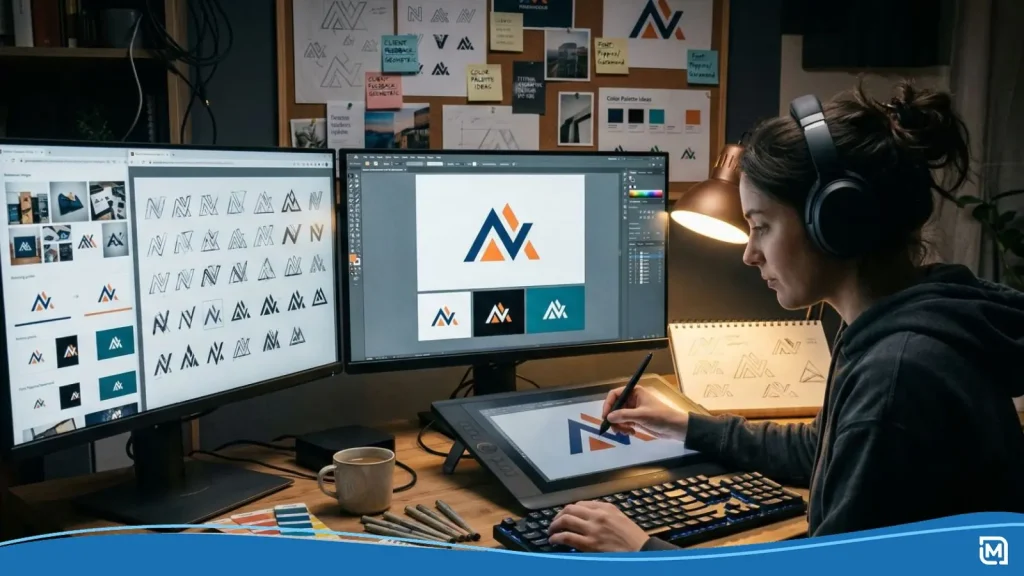
- Brainstorm visually: Look at the logos of businesses you admire, both inside and outside your industry. Note what catches your eye and why. A mood board (even an informal one) helps clarify direction.
- Try a logo maker: Tools like LogoMaker let you generate polished logo concepts in minutes based on your business name, industry, and style preferences. This is the fastest way to see multiple directions without any design experience.
- Shortlist 2 to 3 concepts: Don’t overthink it. Pick the solutions that feel closest to your brand’s personality and are easy to read at small sizes. Ask a few people for quick feedback.
Output: A Simple, Versatile Logo
Your deliverable at this stage is a clean logo that works on a website header, a social media avatar, and a business card. Make sure you have at least a high-resolution PNG file. If your logo maker offers vector formats (SVG, PDF), grab those too. They’ll save you headaches later when you need your logo for print materials.
- Estimated timeline: 1 to 3 days.
- Estimated budget: $0 to $150.
Workflow 2: Launch/Early Growth Stage Logo
Goal: A Logo You Can Scale Across More Touchpoints
Your business is gaining traction. You’ve got customers, a website, and a social media following. Your logo now needs to work harder: across packaging, email templates, ad creatives, signage, and more.
Inputs: What You Know Now That You Didn’t Before
At this stage, you’ve collected real information that should shape your logo design workflow:
- Customer feedback. What do people say about your brand? Does your current logo match their perception?
- Usage data. Where is your logo actually showing up? What sizes and formats do you need it in?
- Basic brand positioning. You have a clearer sense of who you serve, what makes you different, and how you want to be perceived.

Steps: Refine, Create Variations & Define Your Visual Identity
- Evaluate your current logo. Does it still represent what your business has become? If it’s close, refine it rather than starting from scratch.
- Create logo variations. You need more than one version. At minimum: a primary logo (full lockup), a secondary/stacked version, and a standalone icon or symbol. This gives you flexibility across different touchpoints.
- Define color and typography. Lock in your brand colors (2 to 3 primary, 1 to 2 accent) and your font pairings for headings and body text. These choices give your brand a consistent look wherever it appears.
Output: A Full Logo System & Basic Guidelines
Your deliverable is bigger now. You should have:
- A primary logo, secondary logo, and icon version.
- Vector files (AI, EPS, SVG, PDF) and web files (PNG, JPG).
- A simple brand guide covering logo usage, colors (with hex codes), and typography.
Estimated timeline: 2 to 4 weeks.
Estimated budget: $300 to $2,500, depending on whether you refine a logo maker output yourself, work with a freelancer, or run a design contest.
Workflow 3: Rebrand/Established Business Logo
When a Rebrand Is Actually Needed (Not Just Boredom)
Not every established business needs a new logo. A rebrand should be driven by a real business reason, not a whim. Consider it when:
- Your business has changed direction, merged, or expanded into new markets.
- Your visual identity looks dated and no longer reflects who you are.
- Customers consistently misunderstand what you do based on your branding.
- You’re entering a new competitive category and need to differentiate.
- There are legal or trademark issues with your existing brand.
If the main reason is “we’re just tired of it,” that’s a sign you may need a refresh, not a full rebrand.
Inputs: What Established Businesses Must Consider
Rebranding at this stage involves more moving parts:
- Brand equity: What elements of your current brand are people attached to? Changing too much risks confusing loyal customers.
- Competitive positioning: How do your competitors look and communicate? Your new identity needs to stand apart.
- Legal constraints: Trademark searches, naming conflicts, and domain availability all need to be checked.
- Internal alignment: Leadership, marketing, sales, and customer-facing teams must be involved early.
Steps: Audit, Plan, Design, Test & Roll Out
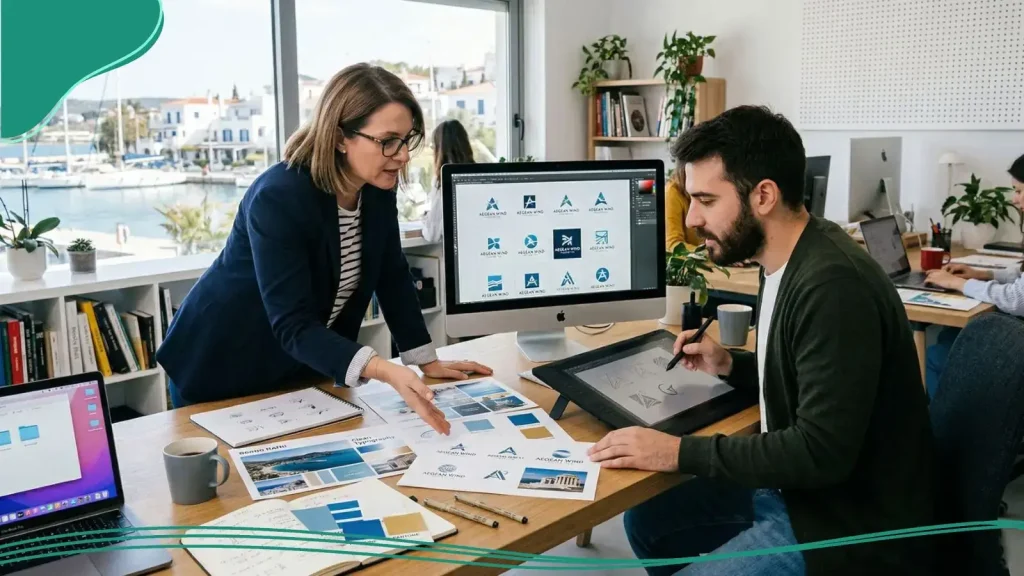
- Conduct a brand audit: Review your current visual identity, messaging, and how customers perceive your brand. Identify what’s working and what isn’t.
- Define brand strategy: Clarify your updated positioning, mission, values, and target audience before any design work begins.
- Explore multiple directions: Work with a designer or agency to develop 3 to 5 distinct logo concepts. Expect 2 to 4 rounds of revisions to get to a final direction.
- Test with real audiences: Show shortlisted concepts to a sample of your customers, employees, and partners. Gather feedback before finalizing.
- Plan your rollout: A phased approach works best. Update high-visibility touchpoints first (website, social media, signage), then work through secondary materials over time.
Output: An Evolved Logo & Full Brand System
Your deliverable at the rebrand stage is the most extensive:
- A new or evolved logo with all variations (primary, secondary, icon, monochrome).
- A complete brand system covering typography, color palette, imagery style, and layout guidelines.
- Rollout communication plan for internal teams and external audiences.
- Updated brand assets for every touchpoint.
Estimated timeline: 4 to 12 weeks for the logo and brand system. Rollout can take additional months.
Estimated budget: $2,500 to $10,000+ for a design studio or agency engagement.
When to Use a Logo Maker vs. Hiring a Designer
The right tool depends on what you’re trying to accomplish with your logo, where to use it, and how much time and budget you have.
| Factor | Logo Maker | Freelance Designer | Agency |
| Best for | Idea and early launch stage | Launch and growth stage | Rebrand and established businesses |
| Cost | $0 to $150 | $300 to $2,500 | $2,500 to $10,000+ |
| Timeline | Minutes to hours | 2 to 4 weeks | 4 to 12 weeks |
| Customization | Template-based with editing tools | Custom based on your brief | Fully custom with strategy |
| Deliverables | PNG, sometimes vector files | Full file set with variations | Full brand system |
| Best when you need | Speed and low cost | Personalized design with revisions | Fully custom design and scalability |
A logo maker like LogoMaker is the smart starting point for idea-stage and launch-stage businesses. You can explore multiple directions in minutes, get a usable logo fast, and invest more in professional design once your business has the revenue to support it.
How to Brief a Designer at Launch vs. Rebrand
If you’re hiring a designer for your launch-stage logo, your brief should cover:
- Your business name and what you do.
- Your target customer.
- 3 to 5 competitor logos you like (and why).
- Preferred colors, fonts, and style (reference your mood board).
- Where your logo will be used.
For a rebrand brief, add:
- Results from your brand audit.
- What you want to keep vs. change.
- Business goals driving the rebrand.
- Internal stakeholders who need to approve the work.
Budget Ranges & Realistic Timelines
| Stage | Approach | Budget | Timeline |
| Idea/Pre-Launch | Logo maker (like LogoMaker) | $0 to $150 | 1 to 3 days |
| Launch/Growth | Freelance designer or refined logo maker output | $300 to $2,500 | 2 to 4 weeks |
| Rebrand/Established | Design studio or branding agency | $2,500 to $10,000+ | 4 to 12 weeks |
How to Avoid Common Logo Design Mistakes at Any Stage
Overcomplicated Shapes & Tiny Details
A logo that looks great at full size on your monitor may turn into an unreadable blob on a business card or social media avatar. Keep shapes simple and avoid fine details that disappear at small sizes. The best logos are recognizable even as a 32×32 pixel favicon.
Chasing Trends vs. Timelessness
It’s tempting to follow whatever design trends are popular right now. But trends fade, and a logo built entirely around a passing style will look dated within a few years. Aim for a design that feels current but won’t need replacing the moment a trend cycle ends.
A good test: Would this logo have looked out of place five years ago? Will it still work five years from now?
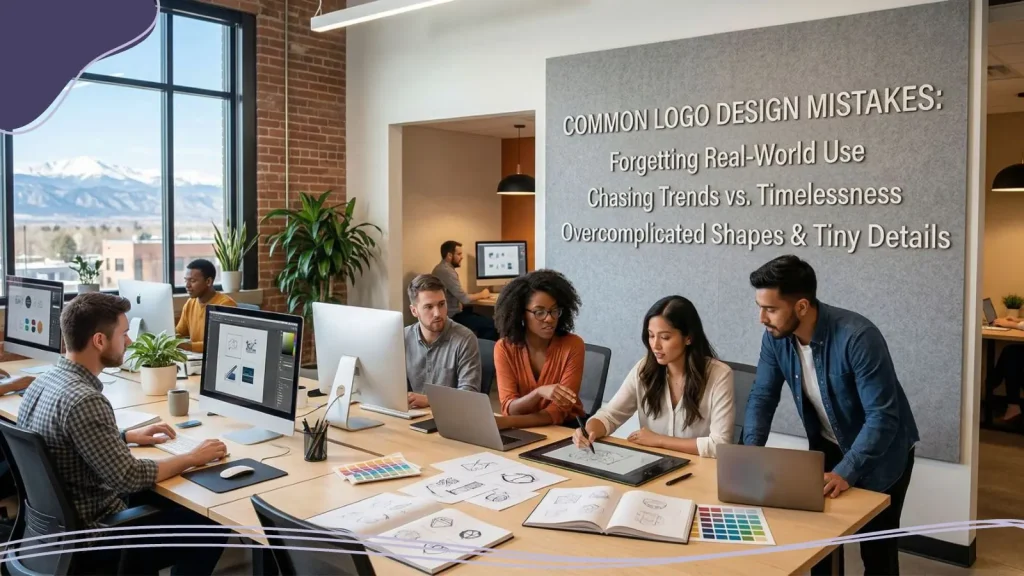
Forgetting Real-World Use
Your logo doesn’t just live on screens. Think about how it will look on:
- Printed materials (business cards, brochures, letterheads).
- Embroidered items (uniforms, hats, bags).
- Signage (storefront, trade show banners).
- Small sizes (browser tabs, app icons, email signatures).
If your logo only works in one format, it’s going to cause problems as your business expands. Always test it in black and white, at small sizes, and on both light and dark backgrounds.
Next Steps: Turn Your Workflow Into a Timeline
A workflow tells you what to do. A timeline tells you when to do it. Turning your process into a concrete schedule keeps you moving forward instead of stalling on decisions or waiting for inspiration to strike.
The right timeline depends on your stage, so here are two practical schedules you can follow right away.
Sample 1-Week Idea-Stage Timeline
| Day | Task |
| Day 1 | Write down your business name, audience, and 2 to 3 brand adjectives. |
| Day 2 | Browse competitor and inspiration logos. Create a quick mood board. |
| Day 3 | Try LogoMaker. Generate 5 to 10 concepts. |
| Day 4 | Shortlist your top 3 options. Get feedback from 2 to 3 people. |
| Day 5 | Pick your logo. Download final files (PNG + vector if available). |
| Day 6 to 7 | Add your logo to your website, social profiles, and business card template. |
Sample 4-Week Launch/Rebrand Timeline
| Week | Task |
| Week 1 | Discovery. Audit current brand (for rebrands). Define goals, audience, and positioning. Write a creative brief. |
| Week 2 | Concept development. Designer presents 2 to 4 initial concepts based on the brief. Review and provide feedback. |
| Week 3 | Refinement. Selected concept gets refined with color, typography, and variations. Round 2 of feedback. |
| Week 4 | Finalization. Approve the final logo. Receive all file formats. Begin basic brand guidelines. Plan rollout (for rebrands). |
For larger rebrands, extend this to 8 to 12 weeks to include strategy work, stakeholder alignment, audience testing, and phased rollout planning.
Pick your stage, pick your timeline, and start today. If you’re at the idea or launch stage, our LogoMaker gets you to your first concept in minutes, no design experience needed.
Ready to start? Try our LogoMaker AI-Powered logo maker now and create your first logo in minutes!
FREQUENTLY ASKED QUESTIONS
How do I know which logo design workflow is right for my business stage?
Ask yourself two questions: Do you have paying customers yet, and do you have a realistic budget for design? If both answers are no, Workflow 1 is your starting point. If you’ve got customers and your logo needs to show up in more places, you’re ready for Workflow 2. An established customer base with a real business reason driving change? That’s Workflow 3 territory.
What files should I always ask for when my logo is finished?
You’ll need a transparent PNG for websites and social media, an SVG or vector PDF for print and merchandise, and a favicon file. At the launch and rebrand stages, also ask for a 1-color version, a stacked and a horizontal lockup, and a simple brand guide with hex codes and font names. Keep everything in one clearly named folder so your printer or developer can find the right file without asking.
What’s the difference between a logo refresh and a full rebrand?
A refresh modernizes your existing identity while keeping its core recognizable: cleaner shapes, updated typography, and a new color tone or two. A full rebrand is a deeper overhaul, with a new concept and often a new direction for the business.
If customers still like your brand but the design looks dated, a refresh is the better starting point. A full rebrand makes sense when the business has fundamentally changed, merged with another company, or when the current identity is actively getting in the way.
Can I trademark a logo I made with a logo maker?
Yes. A logo made with a logo maker can be trademarked if it’s distinctive and doesn’t conflict with existing registered marks. Trademark registration is a separate process from logo ownership and goes through your country’s intellectual property office or a trademark attorney. Run a trademark search before filing to catch any conflicts in your industry.
How many logo concepts should a designer show me?
Two to four concepts are standard for a launch-stage project. For a rebrand, three to five gives you enough range to compare directions without the review becoming a committee exercise. Plan for at least two rounds of revisions after the first presentation.
The more decision-makers you add to the process, the more rounds you’ll need, so keep approvals tight.
How do I avoid picking a logo that looks dated in two years?
A quick test: would this design have looked out of place five years ago, and can you picture it working five years from now? Timeless logos rely on strong, simple shapes and a limited color palette, not decorative details or overly literal illustrations. Using a trend as a light influence rather than the entire concept gives you a logo that feels current without a built-in expiration date.
Do I need a brand guidelines document at the idea stage?
Not yet. At the idea stage, you’d be writing rules for a brand you haven’t tested with real customers. A one-page reference covering your logo variants, hex codes, and font names becomes worth having at the launch stage, when other people start using your logo.
A full guidelines document belongs at the rebrand stage, where larger teams and external partners need a complete reference for imagery, layout, and tone.
What’s the most common logo design mistake at the early stage?
Treating the first logo as a permanent decision. Many successful companies started with a simple logo and improved it as the business grew. Spending weeks and thousands of dollars on a visual identity before your business model is validated is the more expensive mistake; the brand direction often shifts once real customers weigh in. Speed and flexibility matter more than perfection at this stage.
How do I brief a designer if I’ve never done it before?
Start with the basics: your business name, what you do, who your target customer is, three to five logos you like with notes on what appeals to you, and where the logo will be used. If you have color or style preferences, frame them around the business purpose rather than personal taste.
For a rebrand brief, add your brand audit findings, what you want to keep versus change, and who needs to approve the final result.
When does a logo design project officially need more than one week?
When more than one person needs to weigh in, when the logo has to work across multiple formats, or when you need vendor-ready print files. A solo founder using a logo maker can realistically finish in one to three days. Add a freelance designer, multiple reviewers, or a brand guidelines deliverable, and two to four weeks is the realistic minimum. The design itself doesn’t take that long; the review and revision cycles do.